
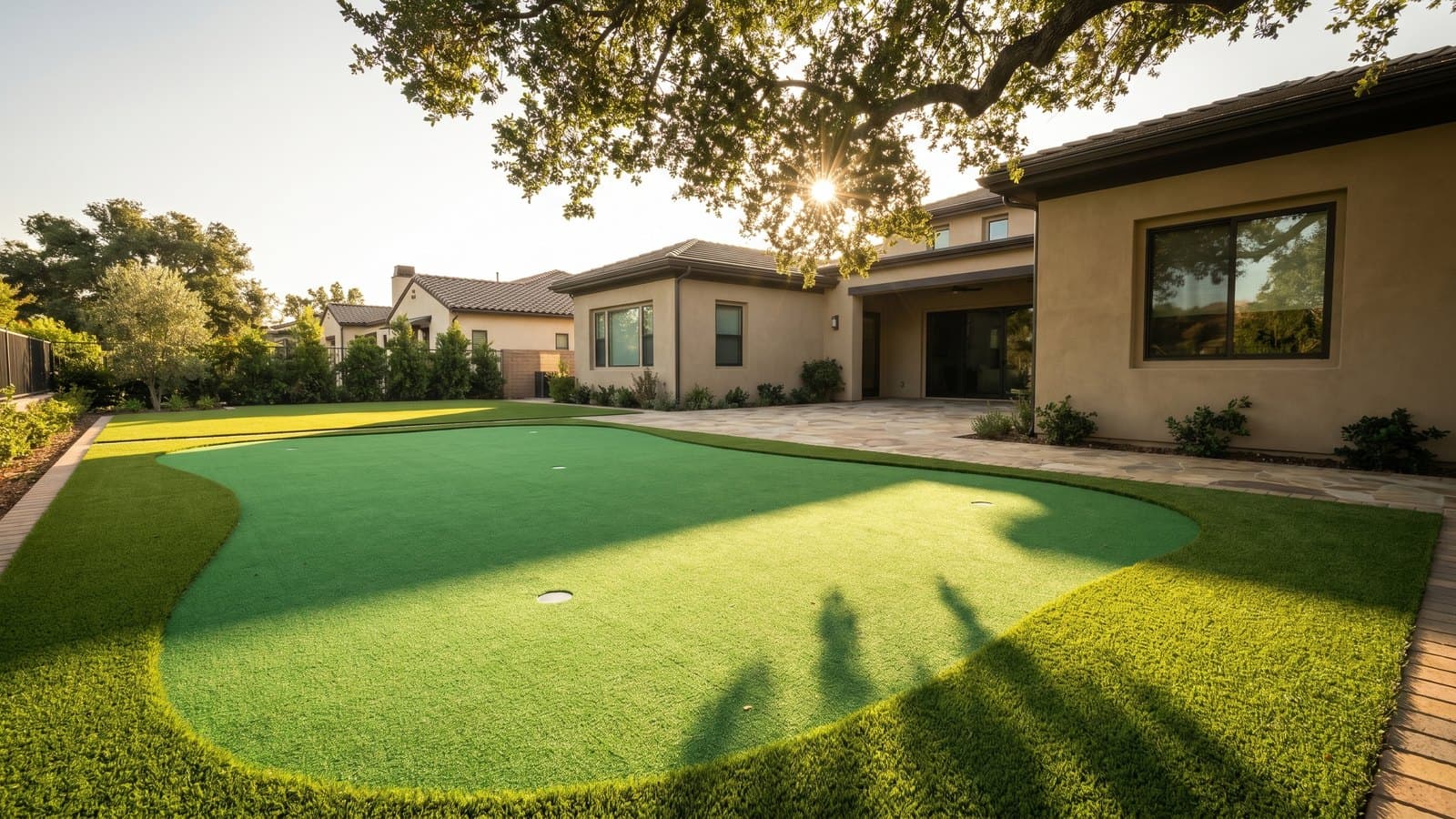
Building a backyard putting green is the closest thing to having a private course. Done right, the green rolls true at Stimpmeter 9 to 10, holds its shape for 15-plus years, and integrates cleanly with the surrounding landscape. Done wrong, the green develops dead spots, inconsistent breaks, and visible base failure within a few seasons. The difference is base prep, product specification, and contour engineering. This guide covers what actually matters when you're commissioning a backyard putting green install.
How Many Cups for Your Yard?
Cup count scales with green size. A 300 to 500 square foot green supports 2 to 3 cups with meaningful break variety. A 600 to 900 square foot green supports 4 to 6 cups. Estate-scale greens (1,000-plus square feet) support 6 to 12 cups with chipping zones and bunkers. More cups mean more practice variety per session but also tighter cup spacing; we typically recommend 4 cups in 600 square feet and 6 in 900 to 1,200 square feet for most homeowners.
Contour Design
Hand-grading the base aggregate is how the contour is built. We work from a hand-drawn contour map showing slope direction, knob locations, tier separations, and any false fronts. Homeowners often want to replicate a signature break from their home course; we can match almost any course-specific shape in 600-plus square feet. The base aggregate is graded by hand, then verified with a level and string lines before turf placement. Contours stay accurate for the life of the install when base compaction is correct.
Base Prep Specifications
Putting green base is more demanding than residential turf base. Specifications: 4 inches of decomposed granite compacted in two 2-inch lifts to 95 percent density, with a finer leveling layer of crushed quartz fines on top. Cups are set with proper ferrules and removable cup-flag plugs. The leveling-fines layer is hand-troweled and verified with a 6-foot straightedge before turf placement. Improper compaction shows up as soft spots within the first season; correct base prep holds for the warranty life.
Product Selection: SYNLawn Precision Putt
SYNLawn Precision Putt is the standard putting green product. Tight-knit fiber profile and roll-true characteristics deliver Stimpmeter 9 to 10 with proper infill and base. Pile height is around 0.5 inches; infill is silica sand brushed in to set fiber upright. Color is natural green. Lifespan under typical home use is 15-plus years. Alternatives exist (other manufacturers' putting products, custom blends) but SYNLawn Precision Putt has the deepest field record in SoCal installs.
Tuning Stimpmeter Speed
Roll speed comes from three factors: fiber pile height (shorter is faster), infill depth and type (more sand infill is faster), and base compaction (firmer is faster). Standard SYNLawn Precision Putt with proper silica sand infill and 95-percent compacted base typically tests at Stimpmeter 9 to 10. We can tune within that range during install. Faster than Stimpmeter 11 requires very firm base, low infill, and a flatter green; not all backyard greens benefit from extreme speed.
Heat Management
Direct-sun synthetic putting greens get hot in SoCal summer afternoons. Inland properties (Calabasas, Thousand Oaks, Woodland Hills, Yorba Linda, Escondido) can see putting green surface temperatures over 130 degrees on August afternoons. Options include shade sails (retractable or fixed), pergola structures, mature shade trees, or strategic timing (morning or evening play). Light spray rinse drops surface temperature significantly. We don't typically use SYNLawn HeatBlock on putting greens because the cooler product line slightly affects roll consistency.
Integration with Surrounding Landscape
Most putting greens integrate with chipping aprons (longer pile fringe simulating a course's chipping rough), sand bunkers (typical white silica sand, sometimes contained with steel edge restraint), and pavers-and-turf patio hardscape. We design the green-to-apron transition with proper edge sealing and the apron-to-fringe area at consistent finish grade. Bunkers can be included where space supports them; typical 100 to 300 square feet with 6-inch sand depth.